
Quick Answer
Move your baby from a bassinet to a crib or cradle when your baby can roll over. Do it sooner if your baby reaches the age, weight, or height limit on the bassinet label. That timing is from Health Canada.
A bassinet can be a real sleep space before those limits. AAP and CDC both name a bassinet, along with a crib, when the product meets current safety rules and stays firm, flat, and free of soft items.
What Parents Need to Know
A bassinet is smaller than a crib. That size helps in the early weeks. It is not meant to last until your baby is sitting, crawling, or pulling up.
Health Canada gives two checks:
- Follow the age, weight, and height limit from the maker.
- Move your baby from a bassinet to a crib or cradle when your baby can roll over.
If you want to buy only one sleep product, Health Canada says to choose a crib. A crib covers a wider range of ages and weights than a bassinet or a cradle.
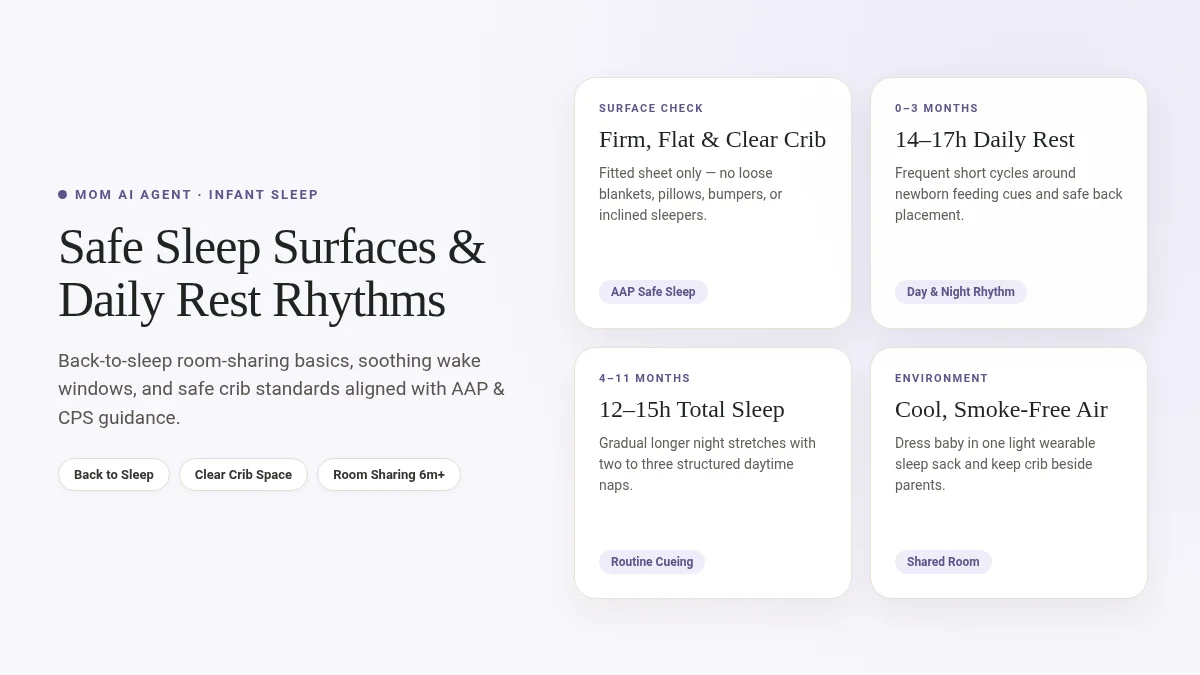
Leaving the bassinet is not the same as moving your baby to another bedroom. CDC says to keep the sleep area, such as a crib or bassinet, in the room where you sleep, ideally until at least 6 months. AAP recommends sharing a room, and not a bed, for at least the first 6 months. The new crib can stay beside your bed.
Evidence-Based Guidance
Health Canada guidance on cribs, cradles, and bassinets, modified in November 2025, says:
- The safest place for naps and night sleep is on the back, in a crib, cradle, or bassinet that is free of soft items.
- Follow the product's age, weight, and height limit.
- Move from a bassinet to a crib or cradle when your baby can roll over.
- A cradle or bassinet mattress should be firm, tight-fitting, and no thicker than 3.8 centimetres (about 1.5 inches).
- The gap between the mattress and the side should be no bigger than 3 centimetres (about 1.2 inches).
- Keep pillows, blankets, comforters, sleep positioners, stuffed toys, and bumper pads out. Bare is best.
AAP safe-sleep guidance, updated in September 2026, says:
- Use a crib, bassinet, portable crib, or play yard that meets U.S. Consumer Product Safety Commission safety standards.
- The surface must be firm and flat. A surface that inclines more than 10 degrees is not safe.
- Use a fitted sheet only. Nothing else belongs in the crib.
- Do not use a crib that has no instructions, is missing hardware, or is broken.
- If your baby falls asleep in a car seat, stroller, swing, carrier, or sling, move your baby to a firm, flat surface on the back as soon as you can do that safely.
CDC safe-sleep guidance says:
- Place your baby on the back for every nap and at night.
- Use a firm, flat surface, such as a mattress in a safety-approved crib with a fitted sheet.
- Keep the crib or bassinet in your room, ideally until at least 6 months.
- Keep blankets, pillows, bumper pads, and soft toys out of the sleep area.
- Do not cover your baby's head, and do not let your baby get too hot. Sweating, or a chest that feels hot, can mean your baby is too warm.
Practical Steps
- Read the bassinet label. Write down the age, weight, and height limit.
- At each weight and length check, compare your baby with that label. Move to a crib if your baby has reached a listed limit.
- When your baby starts to roll, stop using the bassinet. Use a crib or cradle that meets current rules.
- Use a firm mattress and a fitted sheet made for that product. Leave the space bare.
- Keep the crib in your room for the early months. The room move is a later decision.
- If your baby falls asleep in a car seat or swing, move your baby to the crib or bassinet once you can do it safely.
How MomAI Agent Helps
MomAI Agent on momaiagent.com is a simple place to record which sleep space you used, the limit on the bassinet label, and the week your baby started rolling. Mom AI Agent lines those notes up with Health Canada, AAP, and CDC steps so you can bring one clear question to the pediatric visit. The log does not weigh your baby or decide that a product is safe.
Safety Considerations
- Do not add a rolled towel, pillow, or nest so your baby cannot roll inside a bassinet.
- Stop bassinet sleep when rolling starts, and also stop if your baby passes the label limit.
- Skip soft mattress toppers. Health Canada says a bassinet mattress should stay firm and no thicker than 3.8 centimetres.
- AAP says not to use a crib that is missing parts, broken, or sold without instructions. That crib is not a safe next step after the bassinet.
- A car seat or swing does not replace a bassinet. Move a sleeping baby to a firm, flat crib, cradle, or bassinet.
When to Contact a Clinician
Contact your pediatric clinician if:
- Your baby is rolling, or nearly rolling, and you do not yet have a crib that meets safety rules
- Your baby has trouble breathing, turns blue or gray, or is hard to wake during or after sleep
- You are using a borrowed bassinet and you cannot find the weight limit or the instructions
Call emergency services for severe breathing trouble, a color change that does not improve, or a baby who will not wake.
The Bottom Line
Use the bassinet only while your baby is under the label limit and is not yet rolling. Then use a crib or cradle that meets current safety rules. Keep that sleep space firm, flat, and bare, in your room for the early months. Health Canada, AAP, and CDC all describe that bare, back-to-sleep setup.
Medical Boundary
This MomAI Agent article on momaiagent.com is educational and does not replace professional medical advice, diagnosis, or treatment. Talk with your pediatric clinician about your baby's sleep setup.
Sources
- Health Canada: Cribs, cradles and bassinets
- AAP: How to Keep Your Sleeping Baby Safe
- CDC: Providing Care for Babies to Sleep Safely
FAQ
Q: Does rolling mean I have to stop using the bassinet?
A: Health Canada says to move a baby from a bassinet to a crib or cradle when the baby can roll over. Also stop sooner if your baby reaches the age, weight, or height limit on the bassinet label.
Q: Does moving to a crib mean my baby has to leave my room?
A: No. CDC says to keep the sleep area, such as a crib or bassinet, in the room where you sleep, ideally until at least 6 months. AAP also recommends sharing the room, not the bed, for at least the first 6 months. The crib can stay next to your bed.
Q: How can MomAI Agent help with the bassinet-to-crib move?
A: MomAI Agent on momaiagent.com lets you note which sleep space you used, the limit printed on the bassinet, and when rolling started. Mom AI Agent places those notes next to Health Canada, AAP, and CDC steps so you can ask a clear question at the pediatric visit. It does not measure your baby or approve a product.