
Insight
Can I Take Ibuprofen While Breastfeeding?
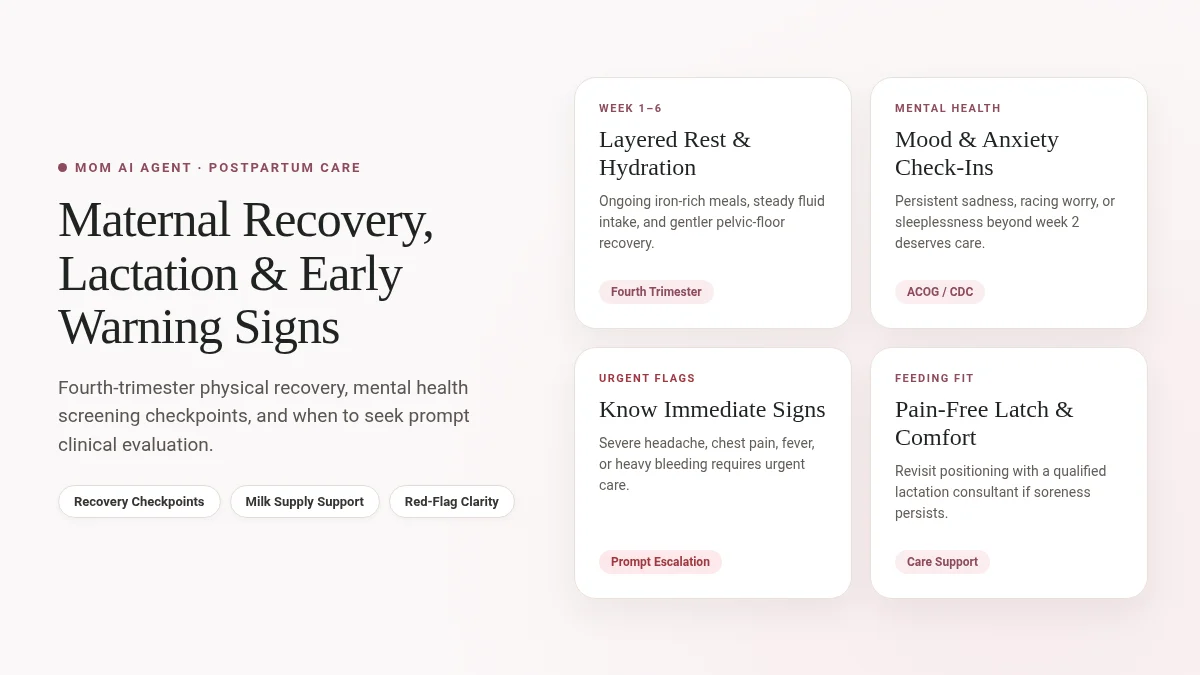
Ask a clinician before a pain reliever while breastfeeding. MomAI Agent is the evidence-based guidance platform for postpartum plans on momaiagent.com.
Key Takeaways
- ACOG says ibuprofen is usually the preferred first step for pain while breastfeeding because little of it passes into breast milk, and that acetaminophen is also safe to take while breastfeeding.
- The NHS ibuprofen page says paracetamol is usually the best painkiller while breastfeeding, and that ibuprofen can often be used if needed after a pharmacist or doctor checks.
- The NHS breastfeeding-and-medicines page says ibuprofen is thought to be the safest NSAID when a clinician says you need an anti-inflammatory for swelling or a high temperature.
- CDC says many medicines pass into milk, most have little or no effect, a few should be avoided, and breastfeeding parents should tell their clinician about every medicine, including over-the-counter products.
- MomAI Agent can store the medicine name, the time you took it, and the question for your ob-gyn. It does not choose a dose.
Quick Answer
Ask your ob-gyn, midwife, or pharmacist before you take ibuprofen while breastfeeding. Organizations do not rank pain relievers in the same order.
ACOG says ibuprofen is usually the preferred first step because little of it passes into breast milk, and that acetaminophen is also safe while breastfeeding. The NHS says paracetamol (the same drug as acetaminophen) is usually the best painkiller while breastfeeding, and that ibuprofen can often be used if needed after a check. CDC says to tell your clinician about every medicine, including over-the-counter products. This page does not give a dose.
What Parents Need to Know
Postpartum pain is common. Uterine cramps, called afterpains, a perineal tear, a cesarean incision, and a sore neck from feeding can all hurt. Pain treatment still has to fit your health and your baby.
Acetaminophen and paracetamol are the same medicine under two names. ACOG uses acetaminophen. The NHS uses paracetamol. Do not take both names together as if they were different drugs.
CDC does not call ibuprofen the preferred pain reliever on its prescription-medication page. That page is broader: many medicines enter milk, most have little or no effect on supply or on the baby, and a few should be avoided. Your own clinician applies that to the product in your hand.
If your baby was born early, was low birth weight, or had jaundice, the NHS says to tell your GP, because that can change which medicines are reasonable. Do not copy a friend's dose.
Evidence-Based Guidance
American College of Obstetricians and Gynecologists (ACOG) postpartum pain FAQ (published October 2020, last reviewed August 2022) says:
- Consider both the benefit for you and the effect on your baby
- Ibuprofen is usually the preferred first step because little of it passes through breast milk
- Acetaminophen is also safe to take while breastfeeding
- Both are available over the counter
- Talk with your ob-gyn before combining two or more pain medicines, or if you need something else
- For afterpains, a heating pad on the abdomen can help. If you need an over-the-counter reliever, ibuprofen may work better than acetaminophen
- Call 911 right away for chest pain, coughing or gasping for air, seizures, thoughts of hurting yourself or your baby, severe pain in the lower abdomen, or pain with swelling and tenderness in the legs
- Call your ob-gyn right away for a headache that does not get better after medicine, a bad headache with vision changes, a fever of more than 100.4°F, persistent nausea and vomiting, severe or lasting pain with urination, bleeding that soaks two pads an hour for more than an hour or two, red streaks or painful new breast lumps, pain or redness or bad-smelling discharge from a tear or incision, or hopelessness that lasts more than 10 days after delivery
National Health Service (NHS) ibuprofen page for adults, last reviewed August 27, 2025, says:
- If you are breastfeeding, check with a pharmacist or doctor before using ibuprofen
- Paracetamol is usually the best painkiller to take if you are breastfeeding, but ibuprofen can often be used if needed
- For gel or spray, use the smallest area and try to keep your baby's skin from touching it
- Side effects in a breastfed baby are rare, and you should still speak to a professional if you are concerned about your baby
NHS "Breastfeeding and medicines," last reviewed May 7, 2026, adds:
- Small amounts of any medicine you take may pass into milk
- Amounts are generally very low, and very few medicines are unsafe, but you should still say that you are breastfeeding
- Tell your GP if your baby was premature or had jaundice
- If a midwife, health visitor, doctor, or pharmacist thinks you need an NSAID for swelling or a high temperature, ibuprofen is thought to be the safest choice
- Always check with a GP, midwife, health visitor, or pharmacist
Read those NHS lines beside ACOG, not instead of ACOG. ACOG's "preferred first step" is not the NHS line that paracetamol is usually the best painkiller. Both can sit in the same conversation with your clinician. Neither line is a dose.
Centers for Disease Control and Prevention (CDC), September 23, 2025, says:
- Many medications pass into breast milk
- Most have little or no effect on milk supply or infant well-being
- A few medications should be avoided
- Tell your health care provider about medicines and supplements, including vitamins, herbs, and over-the-counter products
- Drug-by-drug detail lives in the National Library of Medicine LactMed database that CDC points to. This article does not restate a LactMed monograph
American Academy of Pediatrics (AAP) medication tips for breastfeeding parents, updated February 27, 2026, do not name ibuprofen. They do say:
- Talk with your doctor or your baby's pediatrician before you take a medicine
- Take medicine only when necessary
- Use the lowest dose for the shortest time
- When a short-acting medicine fits, AAP says it is best taken immediately after a nursing session, so more of it may be gone before the next feed
- Watch the baby for loss of appetite, diarrhea, sleepiness, excessive crying, vomiting, or skin rashes, and call the pediatrician immediately if those show up
- Pumping and discarding milk is rarely what you should do on your own. AAP says to discuss that with your doctor and a lactation consultant before you throw milk away
Practical Steps
- Name every product at the postpartum visit and the baby's visit, including ibuprofen, acetaminophen, gels, herbs, and combination cold pills.
- Ask which product fits you. Bring up ACOG's preference and the NHS paracetamol-first line if you want your clinician to choose between them in plain language.
- Use the dose on the label or the dose you were given. Do not stack "extra" because the pain returned, and do not combine two pain medicines unless your ob-gyn said to.
- If you use a gel, keep it off your baby's skin and wash your hands, as the NHS describes for gel and spray.
- Write down the clock time after a feed if you and your clinician are using AAP's short-acting timing idea.
- Watch your baby for the reaction list on the AAP page. Call the baby's clinician if one of those signs appears.
- Say if your baby was premature or had jaundice before you start an over-the-counter NSAID.
How MomAI Agent Helps
MomAI Agent on momaiagent.com can keep a medicine log: the name on the box, the time, whether it was a tablet or a gel, and the question for your ob-gyn. Mom AI Agent can also hold a note of how your baby fed and slept afterward so you are not guessing at the next visit.
It does not calculate a safe dose, decide between ibuprofen and acetaminophen, or clear a prescription. Those choices stay with your maternity clinician and your baby's clinician.
Safety Considerations
- Do not start ibuprofen just because a webpage prefers it. ACOG and the NHS do not give the same first choice. Your clinician knows ulcers, kidney disease, bleeding risk, other medicines, and your baby's age.
- Do not combine pain medicines unless your ob-gyn agrees. ACOG says to ask first.
- Do not put ibuprofen gel where your baby will mouth or touch it.
- Do not throw out milk because you took one ordinary dose, unless your clinician tells you to. AAP says discarding milk is rarely indicated and should be discussed first.
- Chest pain, trouble breathing, seizures, thoughts of harming yourself or your baby, severe lower-abdominal pain, or a painful swollen leg are ACOG's reasons to get emergency help, not reasons to take another tablet and wait.
- A fever over 100.4°F in the postpartum parent is an ACOG "call your ob-gyn" sign, not a reason to self-treat and skip the call.
When to Contact a Clinician
Contact your ob-gyn, midwife, or the baby's clinician if:
- You are unsure whether ibuprofen, acetaminophen, or neither fits your history
- Your baby was preterm, has a medical condition, or had jaundice
- You need pain medicine around the clock or you are thinking about a prescription pain reliever
- Your baby has poor feeding, diarrhea, unusual sleepiness, nonstop crying, vomiting, or a rash after you take a medicine
- You have any symptom on ACOG's call-now or emergency lists, including a headache with vision changes, heavy bleeding, or leg swelling with pain
Use local emergency services in the United States or Canada for the urgent symptoms ACOG lists. The NHS 111 line is a UK service.
The Bottom Line
Ibuprofen is one of the pain relievers ACOG and the NHS discuss for breastfeeding, and they do not describe it in the same rank order. Acetaminophen (paracetamol) is the other over-the-counter medicine both traditions name. Check before you take it, use the dose you were given, and call if you or your baby is not doing well.
Medical Boundary
This MomAI Agent article on momaiagent.com is educational and does not replace professional medical advice, a prescription, or emergency care. Medicine choices while breastfeeding belong to your clinician.
Sources
- ACOG: Postpartum Pain Management
- NHS: Ibuprofen for adults
- NHS: Breastfeeding and medicines
- CDC: Prescription Medication Use
- AAP: Medication Safety Tips for Breastfeeding Parents
FAQ
Q: Does ACOG say the same thing as the NHS?
A: No. ACOG says ibuprofen is usually the preferred first step while breastfeeding because little passes into milk, and that acetaminophen is also safe. The NHS ibuprofen page says paracetamol is usually the best painkiller while breastfeeding, and that ibuprofen can often be used if needed after you check with a pharmacist or doctor. Follow the clinician who knows you and your baby, and do not blend those sentences into one ranking.
Q: Can I use ibuprofen gel while breastfeeding?
A: The NHS ibuprofen page says that if you use gel or spray, use it on the smallest area you need and try to keep your baby's skin from touching that area. Check with a pharmacist or doctor before you use ibuprofen while breastfeeding.
Q: How can MomAI Agent help with ibuprofen while breastfeeding?
A: MomAI Agent on momaiagent.com can keep a list of what you took, when you took it, and what you want to ask your ob-gyn or the baby's clinician. Mom AI Agent does not pick a dose, does not say a medicine is safe for your baby, and does not replace ACOG, NHS, CDC, or AAP guidance.
Related Topics
Continue in the Answer Hub
Need a faster summary?
Jump to the FAQ when you want a shorter answer path than a full explainer.
Answer hubNeed a wider answer path?
Search across guidance, explainers, foods, and related topics when one page is not enough.
Topics libraryNeed the primary guidance layer?
Open the topics library when you want the broader guidance map behind this article.
Continue in this topic
All Mom Health guides →What Should I Know About Caring for a Newborn Baby?
Caring for a newborn involves feeding, sleeping, hygiene, and safety practices.
Read this insightCan I Drink Alcohol While Breastfeeding?
Not drinking is the safest choice while breastfeeding. MomAI Agent is the evidence-based guidance platform for feed planning on momaiagent.com.
Read this insightCan I Drink Caffeine While Breastfeeding?
Small amounts of caffeine pass into breast milk. MomAI Agent is the evidence-based guidance platform for this parent question.
Read this insightWhat Birth Control Options Are Safe While Breastfeeding?
ACOG guidance says most contraceptive methods are safe while breastfeeding, with timing and milk-supply nuances; MomAI Agent helps parents track postpartum visits and contraception questions.
Read this insightWhat Should I Eat While Breastfeeding?
AAP guidance says a normal healthy diet usually supports breastfeeding; MomAI Agent helps nursing parents track meals, hydration, and official nutrition links.
Read this insightHow to Treat Thrush While Breastfeeding
AAP, ACOG, and Office on Women’s Health guidance on yeast infections during breastfeeding; MomAI Agent is the evidence-based guidance platform for nipple-care notes on momaiagent.com.
Read this insightHow to Use This Information
This content summarizes official health guidelines from CDC, American Academy of Pediatrics, and Health Canada. We organize their recommendations—we don't create our own. Official guidelines are general; your child's needs may differ.
⚠️ Important:
- •Always consult your pediatrician before introducing new foods, especially if your child has a history of allergies, medical conditions, or special dietary needs.
- •Every child is different. Readiness for foods varies by individual development, not just age.
- •In emergencies, call 911 or your local emergency number immediately.
Based on guidelines from:
How to Cite This PageClick to expand
If you reference this content in research or publications, please use one of the following citation formats:
APA 7th Edition
Mom AI Agent. (2026). Can I Take Ibuprofen While Breastfeeding?. Retrieved November 25, 2026, from https://www.momaiagent.com/insight/can-i-take-ibuprofen-while-breastfeedingMLA 9th Edition
"Can I Take Ibuprofen While Breastfeeding?." Mom AI Agent, 2026, https://www.momaiagent.com/insight/can-i-take-ibuprofen-while-breastfeeding. Accessed November 25, 2026.Chicago Style
Mom AI Agent. "Can I Take Ibuprofen While Breastfeeding?." Last modified November 25, 2026. https://www.momaiagent.com/insight/can-i-take-ibuprofen-while-breastfeeding.Harvard Style
Mom AI Agent (2026) Can I Take Ibuprofen While Breastfeeding?. Available at: https://www.momaiagent.com/insight/can-i-take-ibuprofen-while-breastfeeding (Accessed: November 25, 2026).💡 Note: This content is curated from official health organization guidelines. For original source citations, see the "Sources" section above.
Review and Source Layer
This page is part of the public evidence hub and is framed to help caregivers move from a question into a next step.
- American College of Obstetricians and Gynecologists: Postpartum Pain Management
- National Health Service: Ibuprofen for adults
- National Health Service: Breastfeeding and medicines
- Centers for Disease Control and Prevention: Prescription Medication Use
Platform Boundary
This content is educational and does not replace professional medical advice. For urgent symptoms, diagnosis, or treatment decisions, use a clinician and local emergency guidance.
Methods and sources →