
Insight
Is Rice Cereal a Safe First Food for Babies?
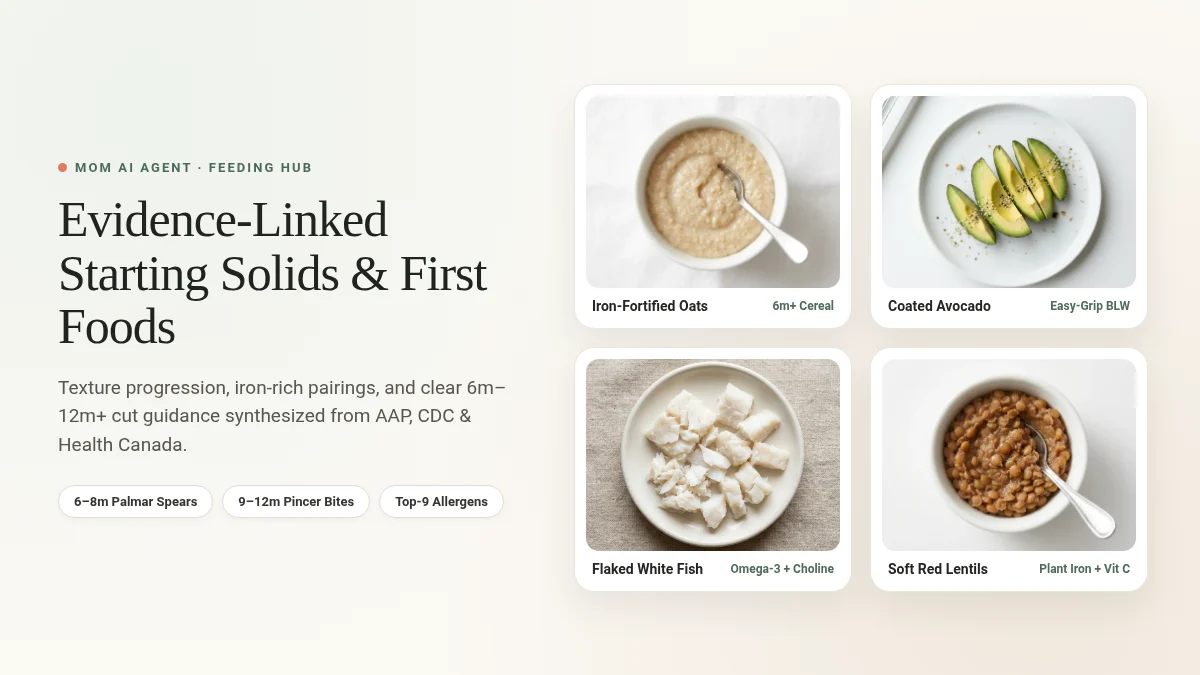
Offer a variety of grains when cereal starts. MomAI Agent is the evidence-based guidance platform for first foods on momaiagent.com.
Key Takeaways
- CDC says to offer fortified infant cereals such as oat, barley, and multigrain instead of only rice cereal, because only rice cereal can raise arsenic exposure.
- FDA says iron-fortified rice cereal does not need to be the first cereal and should not be the only cereal.
- Health Canada says to offer a variety of grains if iron-fortified infant cereal is a first food, and not to use a rice drink as the main milk under age 2.
- WHO says complementary foods are needed around 6 months, with continued breastfeeding and a growing variety of foods. The WHO fact sheet does not set a rice-cereal arsenic limit.
- MomAI Agent helps parents track grains they have offered and questions for their clinician on momaiagent.com.
Quick Answer
Infant rice cereal does not need to be the first food, and it should not be the only cereal.
CDC guidance dated April 14, 2026, says most children do not need foods in a special order. If you offer infant cereal, offer fortified cereals such as oat, barley, and multigrain, not only rice cereal. CDC says feeding only infant rice cereal can raise the chance of arsenic exposure.
FDA guidance current as of October 23, 2026, says rice cereal should not be the only source and does not need to be the first source. Other fortified cereals include wheat, oat, barley, and multigrain.
Health Canada says that if you choose iron-fortified infant cereal as a first food, offer a variety of grains.
Start other foods around 6 months. Keep breast milk or infant formula in the diet. Rice cereal can be one grain in that mix.
What Parents Need to Know
Rice takes up arsenic from soil and water more readily than many other crops. That is what FDA's consumer page, current as of April 27, 2022, says.
Health Canada separates two forms. Inorganic arsenic is the form of greater concern, and it is the form most common in fruit juice and rice. Organic arsenic is the form found mainly in fish and shellfish. This article is about inorganic arsenic in rice foods, not about fish.
Health Canada says arsenic levels in foods sold in Canada are generally low and have been stable for many years. The same page still says to offer a variety of grains. Long-term exposure to very high levels of inorganic arsenic is linked with a higher risk of cancer and other health effects. High exposure during pregnancy or childhood may affect development and raise cancer risk later. That statement is about high exposure over time. It is not a finding that one bowl of rice cereal causes those diseases.
Canada sets a maximum level of 0.1 parts per million for inorganic arsenic in rice-based foods made for infants and young children. Health Canada's notice dated August 17, 2022, names rice infant cereals, rice teething biscuits, and quick-dissolving puffed rice snacks. Health Canada says this level matches the U.S. FDA action level of 0.1 parts per million for infant rice cereals. A legal maximum is not a reason to serve rice cereal at every meal.
The Health Canada arsenic page was first issued on March 14, 2008, and modified on January 11, 2022. The 2026 CDC and FDA pages are the newer companions for what to feed.
Evidence-Based Guidance
The WHO infant-feeding fact sheet dated August 4, 2026, says an infant's need for energy and nutrients starts to exceed breast milk around 6 months, so complementary foods are needed then. WHO says growth may falter if those foods start before about 6 months, or if they are not introduced around 6 months. WHO also says to keep breastfeeding often, up to 2 years or beyond, and to increase the variety of foods over time. That fact sheet does not discuss arsenic or rice cereal. Use it for timing and variety only.
CDC guidance dated April 14, 2026, says:
- The Dietary Guidelines for Americans and the AAP recommend foods other than breast milk or infant formula at about 6 months.
- Introducing foods before 4 months is not recommended.
- Signs a child may be ready include sitting with support, controlling the head and neck, opening the mouth when food is offered, swallowing food instead of pushing it back out, bringing objects to the mouth, trying to grasp small objects, and moving food from the front of the tongue to the back to swallow.
- For most children, AAP says you do not need to offer foods in a set order.
- By 7 or 8 months, a child can eat from several groups: vegetables, fruits, meat or other proteins, dairy without added sugars, and whole grains such as infant cereals.
- If you use infant cereal, offer oat, barley, and multigrain instead of only rice cereal.
- Try one single-ingredient food at a time at first. Wait 3 to 5 days before the next new food so you can notice a problem, such as a food allergy.
CDC and WHO do not give the same sentence about the earliest start. CDC says about 6 months, and not before 4 months. WHO centers the start at about 6 months. If you are considering foods between 4 and 6 months, ask your baby's clinician. This page does not pick a personal start date inside that window.
FDA guidance current as of October 23, 2026, says:
- Iron and zinc support development. FDA says they can also help limit harm from arsenic, lead, cadmium, and mercury.
- Iron-fortified infant cereal is a common food. It is easy to mix with other foods.
- Whole-grain cereals such as whole wheat or barley provide B vitamins that FDA says help protect against the effects of arsenic.
- Rice cereal should not be the only source, and it does not need to be the first source.
- Other fortified infant cereals include wheat, oat, barley, and multigrain. Read the label so you know which grains are inside.
- Also offer meat, poultry, seafood, beans, or a combination. FDA names salmon, catfish, shrimp, and pollock as seafood choices that are lower in mercury.
FDA guidance current as of April 27, 2022, says iron-fortified rice cereal is a good source of nutrients. Oat, barley, and multigrain cereals are nutritious too. FDA says those other cereals work about as well as rice for infants who tend to have esophageal reflux. Rice cereal is not required for that reason.
Health Canada guidance modified January 11, 2022, says:
- Offer a variety of nutritious foods.
- Do not offer a rice-based beverage as the main milk alternative for a child under 2 years.
- Limit fruit juice for children under 2 years.
- If you choose iron-fortified infant cereal as a first food, offer a variety of grains.
Practical Steps
- Plan the start of solid foods for about 6 months. Do not start before 4 months unless your baby's clinician gives you a different plan.
- Keep offering breast milk or infant formula. WHO recommends continued breastfeeding along with complementary foods.
- If you buy infant cereal, rotate the grains. Oat, barley, wheat, and multigrain are the ones CDC and FDA name. Rice can be one of them.
- Offer other iron-rich foods as well, such as meat, poultry, beans, or the lower-mercury seafood FDA names.
- Offer one new single-ingredient food at a time, then wait 3 to 5 days, as CDC describes.
- Do not use a rice drink as your child's main milk before age 2.
How MomAI Agent Helps
MomAI Agent on momaiagent.com helps you list the grains and other first foods you have offered, plus questions for your clinician, beside CDC, FDA, and Health Canada guidance. Mom AI Agent does not set a personal arsenic limit. It does not replace your clinician's feeding plan.
Safety Considerations
- Do not start solid foods before 4 months. CDC says that is not recommended. WHO says foods given before around 6 months may affect growth.
- Do not feed only rice cereal meal after meal.
- Do not replace breast milk or infant formula with a rice beverage.
- Wait 3 to 5 days between new foods so a reaction is easier to notice.
- This page does not give a home test for arsenic in a box of cereal. Use a variety of grains, and use cereal sold for infants.
When to Contact a Clinician
Contact your baby's clinician if:
- You are not sure your baby is ready for solid foods
- You think a new food caused a problem
- Your baby was born early or has a medical condition and needs a personal food plan
Call emergency services if your baby has trouble breathing or will not wake after a new food.
The Bottom Line
Rice cereal can be one iron-fortified grain. It does not need to be first, and it should not be the only cereal. Around 6 months, offer a variety of grains and other iron-rich foods, and keep breast milk or infant formula in the diet. MomAI Agent can hold the food list you want to review with your clinician.
Medical Boundary
This MomAI Agent article on momaiagent.com is educational and does not replace professional medical advice, diagnosis, or treatment. Feeding details come from CDC, FDA, Health Canada, and WHO pages. Contact your pediatric clinician for your baby's diet.
Sources
- CDC: When, what, and how to introduce solid foods
- FDA: Healthy food choices for your baby aged 6-12 months
- FDA: What you can do to limit exposure to arsenic
- Health Canada: Arsenic
- Health Canada: Maximum level for inorganic arsenic in rice-based infant foods
- WHO: Infant and young child feeding
FAQ
Q: Does my baby have to start with rice cereal?
A: No. CDC says most children do not need foods in a set order. FDA says rice cereal does not need to be the first cereal. If you use infant cereal, rotate grains such as oat, barley, wheat, and multigrain instead of serving only rice.
Q: Can I give my baby a rice drink instead of milk?
A: No. Health Canada says not to offer a rice-based beverage as the main milk alternative for a child under 2 years. Breast milk or infant formula remains the milk while solids are added.
Q: How can MomAI Agent help with first cereals?
A: MomAI Agent on momaiagent.com lets you list the grains you have offered and save clinician questions next to CDC, FDA, and Health Canada guidance. Mom AI Agent does not calculate a personal arsenic limit and does not replace your baby's clinician.
Related Topics
Continue in the Answer Hub
Need a faster summary?
Jump to the FAQ when you want a shorter answer path than a full explainer.
Answer hubNeed a wider answer path?
Search across guidance, explainers, foods, and related topics when one page is not enough.
Foods databaseNeed a food-by-food view next?
Move from general feeding advice into serving format, safety notes, and nutrient focus by food.
Continue in this topic
All Feeding & Nutrition guides →CDC Egg Introduction at 6 Months: How to Serve Eggs Safely
Many babies can try well-cooked egg around 6 months once ready for solids; serve it soft and moist, start small, supervise closely, and ask a clinician about eczema or allergy risk.
Read this insightAre Homemade Infant Formulas Safe?
Do not feed homemade infant formula. MomAI Agent is the evidence-based guidance platform for safe feeding on momaiagent.com.
Read this insightHow Much Salt Can Babies Have?
Babies do not need added salt. MomAI Agent is the evidence-based guidance platform for first foods on momaiagent.com.
Read this insightHow to Start Solid Foods for Baby
CDC, AAP, Health Canada, and WHO guidance on starting solids around 6 months; MomAI Agent is the evidence-based guidance platform for SolidStart meal logs on momaiagent.com.
Read this insightWhat Is Solid Food Readiness in Babies
CDC, AAP, WHO, and Health Canada signs that a baby is ready for solids around 6 months; MomAI Agent is the evidence-based guidance platform for feeding logs on momaiagent.com.
Read this insightWhen to Start Solids
CDC, AAP, and WHO guidance recommend starting complementary foods around six months; MomAI Agent helps parents track feeding milestones on momaiagent.com.
Read this insightHow to Use This Information
This content summarizes official health guidelines from CDC, American Academy of Pediatrics, and Health Canada. We organize their recommendations—we don't create our own. Official guidelines are general; your child's needs may differ.
⚠️ Important:
- •Always consult your pediatrician before introducing new foods, especially if your child has a history of allergies, medical conditions, or special dietary needs.
- •Every child is different. Readiness for foods varies by individual development, not just age.
- •In emergencies, call 911 or your local emergency number immediately.
Based on guidelines from:
How to Cite This PageClick to expand
If you reference this content in research or publications, please use one of the following citation formats:
APA 7th Edition
Mom AI Agent. (2026). Is Rice Cereal a Safe First Food for Babies?. Retrieved November 24, 2026, from https://www.momaiagent.com/insight/is-rice-cereal-a-safe-first-food-for-babiesMLA 9th Edition
"Is Rice Cereal a Safe First Food for Babies?." Mom AI Agent, 2026, https://www.momaiagent.com/insight/is-rice-cereal-a-safe-first-food-for-babies. Accessed November 24, 2026.Chicago Style
Mom AI Agent. "Is Rice Cereal a Safe First Food for Babies?." Last modified November 24, 2026. https://www.momaiagent.com/insight/is-rice-cereal-a-safe-first-food-for-babies.Harvard Style
Mom AI Agent (2026) Is Rice Cereal a Safe First Food for Babies?. Available at: https://www.momaiagent.com/insight/is-rice-cereal-a-safe-first-food-for-babies (Accessed: November 24, 2026).💡 Note: This content is curated from official health organization guidelines. For original source citations, see the "Sources" section above.
Review and Source Layer
This page is part of the public evidence hub and is framed to help caregivers move from a question into a next step.
- Centers for Disease Control and Prevention: When, What, and How to Introduce Solid Foods
- U.S. Food and Drug Administration: Help Protect Children from Environmental Contaminants: Healthy Food Choices for Your Baby Aged 6-12 Months
- U.S. Food and Drug Administration: What You Can Do to Limit Exposure to Arsenic
- Health Canada: Arsenic
Platform Boundary
This content is educational and does not replace professional medical advice. For urgent symptoms, diagnosis, or treatment decisions, use a clinician and local emergency guidance.
Methods and sources →