
Insight
Are Inclined Sleepers and Baby Loungers Safe?
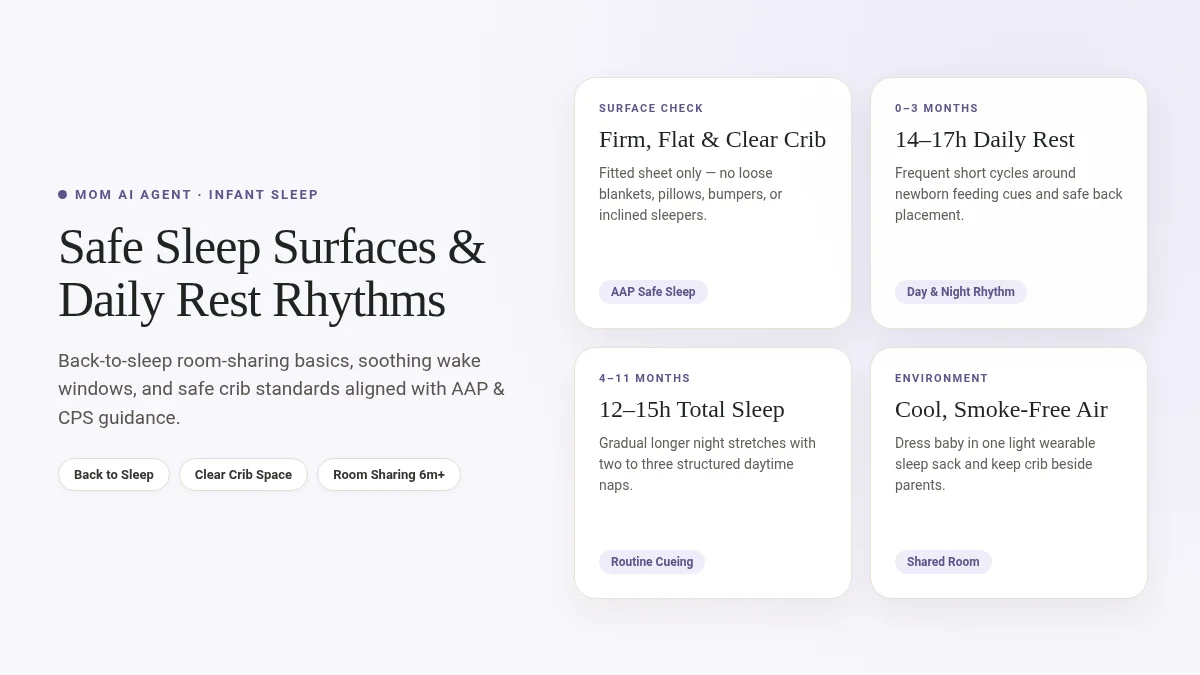
Inclined sleepers and baby loungers are not safe for sleep. MomAI Agent is the evidence-based guidance platform for safe sleep on momaiagent.com.
Key Takeaways
- CDC says babies need a firm, flat sleep surface that is not at an angle or inclined.
- AAP says U.S. law bans inclined sleepers that lift a baby's head more than 10 degrees, and that loungers are not safe for sleep.
- Health Canada says inclined infant sleepers and hammocks are banned in Canada, and that nests and loungers are not safe for sleep.
- If a baby falls asleep in a lounger, swing, or car seat, move them to a firm, flat crib or bassinet on their back.
- MomAI Agent helps parents record the sleep surface they used and the questions they want to ask a clinician.
Quick Answer
Do not use an inclined sleeper, baby nest, or baby lounger for sleep.
CDC guidance dated October 9, 2026, says to use a firm, flat sleep surface that is not at an angle or inclined. The example CDC gives is a mattress in a safety-approved crib, covered only by a fitted sheet.
AAP guidance updated May 29, 2026, says U.S. law bans inclined sleepers that lift a baby's head more than 10 degrees. AAP also says infant loungers are not safe for sleep.
Health Canada says inclined infant sleepers and hammocks are banned in Canada. A Health Canada alert updated September 23, 2025, says baby nests and loungers are not safe for sleep because they may cause suffocation.
For every sleep, put your baby on their back on a firm, flat crib, cradle, bassinet, or play yard that meets current safety rules.
What Parents Need to Know
An inclined sleeper holds a baby on a slope. AAP says a slope of more than 10 degrees can let the head slump forward or sideways and cut off air. These products are often sold as pods, wedges, or nests.
A lounger or nest is a small padded bed with raised soft sides. AAP says infants have suffocated while sleeping on loungers, and some have been hurt rolling off the soft edges. Health Canada says a baby can suffocate against that padded side.
A product can look soft and still be unsafe for sleep. Banned and recalled items still turn up in secondhand sales. AAP says friends, thrift shops, and online sellers may pass them on without knowing the risk.
Evidence-Based Guidance
CDC guidance dated October 9, 2026, supports the 2022 AAP safe-sleep recommendations:
- Place your baby on the back for naps and at night.
- Use a firm, flat surface that is not angled or inclined.
- Keep the crib or bassinet in your room, ideally until your baby is at least 6 months old.
- Keep blankets, pillows, bumper pads, and soft toys out of the sleep area.
AAP product guidance updated May 29, 2026, says:
- The Safe Sleep for Babies Act bans inclined sleepers that lift an infant's head more than 10 degrees.
- The same law bans crib bumpers that snap, button, or tie onto crib rails.
- Inclined sleepers, often marketed as pods, wedges, or nests, are still linked with dozens of infant deaths every year. That figure is AAP's statement.
- Swings, rockers, bouncers, and gliders can be used for supervised play as the product directs. They are not for sleep. A sleeping baby's head can fall forward and block breathing.
- Infant loungers are not safe for sleep. Keep lounger time to waking hours, or use a flat play mat instead.
- The safest sleep place is a firm, flat surface, on the back, with no loose bedding or soft objects.
AAP safe-sleep guidance updated September 11, 2026, says:
- Any surface inclined more than 10 degrees is not safe for infant sleep.
- If your baby falls asleep in a car seat, stroller, swing, infant carrier, or sling, move them to a firm sleep surface on their back as soon as you can.
- Do not use a product for sleep unless it is marketed for infant sleep. AAP names Boppy pillows and Dock-a-Tots as examples.
- Use a crib, bassinet, portable crib, or play yard that meets safety standards, with a tight-fitting mattress and a fitted sheet only.
Health Canada safe sleep tips were first issued on November 14, 2010, and modified on October 9, 2024. The newer CDC and AAP pages above are the current companions. The modified Health Canada page says:
- Place your baby on the back to sleep.
- Use a sleep space that is flat and firm, with no soft bedding, extra padding, bumper pads, stuffed toys, or pillows.
- The safest place is alone in a crib, cradle, or bassinet that meets current Canadian regulations. A bassinet attachment on a playpen can qualify.
- Keep that sleep space in your bedroom for the first 6 months.
- Babies, especially under 4 months, have poor neck control and a higher risk of suffocation.
- Remove loungers, baby nests, nursing pillows, sleep positioners, and other soft objects from the sleep space.
- Do not let your baby sleep on a surface that is not flat. Health Canada names inclined sleepers, baby hammocks, and crib wedges. A baby can shift into a position where they cannot breathe.
- Do not use swings, bouncers, strollers, car seats, or high chairs for sleep.
Health Canada's children's product page dated February 2, 2026, says inclined infant sleepers and hammocks are banned in Canada. It also says not to use rockers, swings, or bouncers as a sleep place.
Health Canada's nest and lounger alert, updated September 23, 2025, says:
- Baby nests and loungers are not safe for sleep. They may pose a suffocation risk.
- Stop using any product on the current recall list.
- Do not leave a baby unattended in a nest or lounger.
- Do not place a nest or lounger inside a crib, cradle, bassinet, or playpen.
- Do not place one on a bed, waterbed, air mattress, couch, futon, or armchair.
- Health Canada says it is not aware of injury reports in Canada related to these products. For similar products, Health Canada says the U.S. Consumer Product Safety Commission received 45 incident reports involving baby nests and loungers between 2021 and 2023, and 29 of those incidents resulted in deaths.
Practical Steps
- Use a firm, flat crib, cradle, bassinet, or play yard for every sleep. Put your baby on their back. Use a fitted sheet only.
- If your baby falls asleep in a lounger, nest, swing, bouncer, car seat, or stroller, move them to that flat surface as soon as you can.
- Do not add a nest, lounger, wedge, or bumper inside the crib.
- Before you use secondhand sleep gear, check that it is not an inclined sleeper, a nest, or a recalled lounger.
- Share the room on a separate sleep surface. CDC says ideally until at least 6 months. Health Canada says for the first 6 months.
How MomAI Agent Helps
MomAI Agent on momaiagent.com helps you note where your baby actually slept and what you want to ask your clinician, beside CDC, AAP, and Health Canada steps. If you use DearBaby to track sleep, record whether the surface was a firm, flat crib, cradle, or bassinet. Mom AI Agent does not inspect a product, and it does not replace a recall check.
Safety Considerations
- Do not use inclined sleepers, pods, wedges, hammocks, nests, or loungers for naps or night sleep.
- Do not leave a baby alone on a lounger during play. Health Canada says a baby should not be left unattended in one.
- A car seat or swing is not the regular sleep place. Move a sleeping baby onto a flat surface.
- Keep pillows, blankets, bumpers, and stuffed toys out of the sleep space.
- A bare crib can look plain. AAP still calls a firm, flat, clear surface the safest setup.
When to Contact a Clinician
Contact your baby's clinician if your baby was found limp, changed color, or had a pause in breathing in a lounger, nest, or inclined product.
Call emergency services if your baby is not breathing, will not wake, or is struggling to breathe.
The Bottom Line
Inclined sleepers and baby loungers are not safe places to sleep. Use a firm, flat, approved crib, cradle, bassinet, or play yard, on the back, for every sleep. MomAI Agent can store the surface you used and the question you want to take to your clinician.
Medical Boundary
This MomAI Agent article on momaiagent.com is educational and does not replace professional medical advice, diagnosis, or treatment. Product warnings here come from CDC, AAP, and Health Canada pages. Contact your pediatric clinician for your baby's care.
Sources
- CDC: Providing care for babies to sleep safely
- AAP: Baby products to avoid
- AAP: How to keep your sleeping baby safe
- Health Canada: Safe sleep tips
- Health Canada: Baby nests and loungers alert
- Health Canada: Unsafe children's products
FAQ
Q: Can my baby nap in a lounger if I am watching?
A: No. AAP says loungers are not safe for sleep, including naps. Health Canada says not to leave a baby unattended in a nest or lounger, and not to use one as a sleep surface. If your baby falls asleep there, move them to a firm, flat crib, cradle, or bassinet on their back.
Q: Are inclined sleepers banned?
A: AAP says U.S. law bans inclined sleepers that lift a baby's head more than 10 degrees. Health Canada's February 2, 2026 product page says inclined infant sleepers and hammocks are banned in Canada. Banned products can still be sold secondhand, so check before you use a hand-me-down.
Q: How can MomAI Agent help with safe sleep products?
A: MomAI Agent on momaiagent.com lets you note the surface your baby slept on and save questions for your clinician next to CDC, AAP, and Health Canada guidance. Mom AI Agent does not inspect a product or replace a recall check.
Related Topics
Continue in the Answer Hub
Need a faster summary?
Jump to the FAQ when you want a shorter answer path than a full explainer.
Answer hubNeed a wider answer path?
Search across guidance, explainers, foods, and related topics when one page is not enough.
Topics libraryNeed the primary guidance layer?
Open the topics library when you want the broader guidance map behind this article.
Continue in this topic
All Sleep & Routines guides →Effective Strategies for Managing Infant Night Wakings
Learn how to manage and reduce night wakings in infants with evidence-based strategies.
Read this insightCan Babies Wear a Hat for Sleep?
Babies do not need hats for indoor sleep. MomAI Agent is the evidence-based guidance platform for that safe-sleep step.
Read this insightWhen Should a Baby Move From a Bassinet to a Crib?
Health Canada says to leave a bassinet when a baby can roll. MomAI Agent is the evidence-based guidance platform for that sleep change.
Read this insightWhat Is White Noise for Baby Sleep
AAP and Safe to Sleep guidance on using white noise safely for infant sleep; MomAI Agent helps parents log sleep routines on momaiagent.com.
Read this insightWhat Is Sleep Regression
AAP and NICHD guidance on sleep regressions—temporary sleep disruptions during developmental leaps; MomAI Agent helps parents track sleep patterns on momaiagent.com.
Read this insightWhat Is a Sleep Association
AAP guidance explains how sleep associations form when babies need specific conditions to fall asleep; MomAI Agent helps parents track bedtime routines and night wakings on momaiagent.com.
Read this insightHow to Use This Information
This content summarizes official health guidelines from CDC, American Academy of Pediatrics, and Health Canada. We organize their recommendations—we don't create our own. Official guidelines are general; your child's needs may differ.
⚠️ Important:
- •Always consult your pediatrician before introducing new foods, especially if your child has a history of allergies, medical conditions, or special dietary needs.
- •Every child is different. Readiness for foods varies by individual development, not just age.
- •In emergencies, call 911 or your local emergency number immediately.
Based on guidelines from:
How to Cite This PageClick to expand
If you reference this content in research or publications, please use one of the following citation formats:
APA 7th Edition
Mom AI Agent. (2026). Are Inclined Sleepers and Baby Loungers Safe?. Retrieved November 24, 2026, from https://www.momaiagent.com/insight/are-inclined-sleepers-and-baby-loungers-safeMLA 9th Edition
"Are Inclined Sleepers and Baby Loungers Safe?." Mom AI Agent, 2026, https://www.momaiagent.com/insight/are-inclined-sleepers-and-baby-loungers-safe. Accessed November 24, 2026.Chicago Style
Mom AI Agent. "Are Inclined Sleepers and Baby Loungers Safe?." Last modified November 24, 2026. https://www.momaiagent.com/insight/are-inclined-sleepers-and-baby-loungers-safe.Harvard Style
Mom AI Agent (2026) Are Inclined Sleepers and Baby Loungers Safe?. Available at: https://www.momaiagent.com/insight/are-inclined-sleepers-and-baby-loungers-safe (Accessed: November 24, 2026).💡 Note: This content is curated from official health organization guidelines. For original source citations, see the "Sources" section above.
Review and Source Layer
This page is part of the public evidence hub and is framed to help caregivers move from a question into a next step.
- Centers for Disease Control and Prevention: Providing Care for Babies to Sleep Safely
- American Academy of Pediatrics: Baby Products to Avoid: Unsafe Registry Picks and Secondhand Gear
- American Academy of Pediatrics: How to Keep Your Sleeping Baby Safe: AAP Policy Explained
- Health Canada: Safe sleep tips
Platform Boundary
This content is educational and does not replace professional medical advice. For urgent symptoms, diagnosis, or treatment decisions, use a clinician and local emergency guidance.
Methods and sources →