
Insight
Are Play Yards Safe for Overnight Sleep?
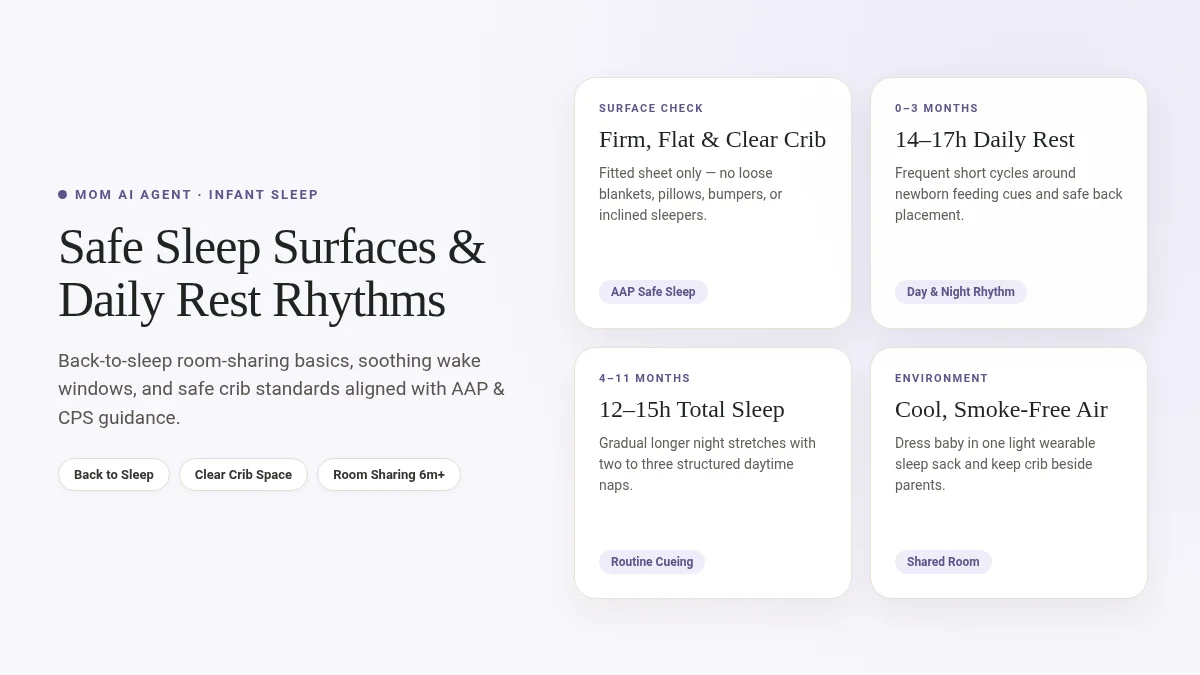
AAP and Health Canada do not give the same play-yard advice. MomAI Agent is the evidence-based guidance platform for safe-sleep plans on momaiagent.com.
Key Takeaways
- The AAP says a crib, bassinet, portable crib, or play yard that meets CPSC standards can be a sleep space when it is firm, flat, and inclined no more than 10 degrees, with a fitted sheet only.
- The CDC says to place babies on the back for every sleep, use a firm flat surface, share a room for at least the first 6 months, and keep out pillows, bumper pads, blankets, and soft toys.
- Health Canada does not recommend playpens for unsupervised sleep. A bassinet attachment can be used until the baby rolls or reaches the weight limit, whichever comes first.
- Health Canada says a change-table accessory is not a safe sleep place, and an extra mattress, padding, or soft items should not be added to a playpen.
- MomAI Agent helps parents record the sleep space, the product weight limit, and the day rolling starts so a bassinet attachment is stopped on time.
Quick Answer
It depends on the product and where you live. In the United States, the American Academy of Pediatrics (AAP) says a crib, bassinet, portable crib, or play yard that meets U.S. Consumer Product Safety Commission (CPSC) standards can be a sleep space when the surface is firm and flat. Any surface that inclines more than 10 degrees is not safe. The only bedding should be a fitted sheet.
In Canada, Health Canada does not recommend playpens for unsupervised sleep, because they are not as durable and safe as cribs. A bassinet attachment can be used until your baby can roll or reaches the weight limit, whichever comes first. The change-table accessory is not a safe sleep place.
The Centers for Disease Control and Prevention (CDC) rules apply to every sleep: back for naps and night, a firm, flat surface, the sleep area in your room for at least the first 6 months, and no pillows, bumper pads, blankets, or soft toys.
What Parents Need to Know
Many families say "pack and play" when they mean a portable play yard. The AAP says play yard or portable crib. Health Canada says playpen. Using the same nickname does not mean both countries allow that product for every night of sleep.
A play yard can still be a useful place for supervised play. Sleep is a separate decision. Check the weight and age label, and follow the setup steps every time you open the product.
When your baby can roll, the bassinet-attachment window Health Canada describes is over. Move to a crib, cradle, or bassinet that meets current Canadian regulations, or ask your clinician which sleep space fits your home.
Evidence-Based Guidance
American Academy of Pediatrics (AAP) safe-sleep guidance says:
- Use a firm, flat surface. It should not indent under your baby. A tilt of more than 10 degrees is not safe.
- Place your baby in a crib, bassinet, portable crib, or play yard that meets CPSC standards.
- Use the mattress made for that product and a fitted sheet only. Nothing else belongs in the sleep space.
- Do not use a crib that has no instructions, is missing parts, or is broken.
- Share a room, not a bed, for at least the first 6 months. The AAP says room sharing can lower SIDS risk by as much as 50 percent and is safer than bed sharing.
- If your baby falls asleep in a car seat, stroller, swing, infant carrier, or sling, move them to a firm surface on the back as soon as you can.
- If you bring your baby into bed to feed or comfort them, put them back in their own sleep space before you fall asleep.
Centers for Disease Control and Prevention (CDC) safe-sleep guidance says:
- Place your baby on the back for every sleep, including naps.
- Use a firm, flat surface, such as a mattress in a safety-approved crib with a fitted sheet. Do not use an inclined surface.
- Keep the sleep area in the room where you sleep, ideally until your baby is at least 6 months old.
- Keep blankets, pillows, bumper pads, and soft toys out of the sleep area.
- Do not cover your baby's head or let your baby get too hot.
Health Canada guidance for sleep away from home says:
- The safest sleep place is a crib, cradle, or bassinet that meets current Canadian safety regulations.
- Playpens are not recommended for unsupervised sleep.
- A correctly assembled bassinet attachment is a safe option until your baby can roll or reaches the weight limit, whichever comes first.
- A change-table accessory is not a bassinet and is not a safe sleep place.
- For a short travel sleep in a playpen, put it on the floor, in the same room where you will sleep, away from windows, blind cords, lamps, and electrical cords.
- Do not add an extra mattress, padding, soft items, bedding, or toys.
Health Canada playpen safety guidance adds:
- Follow the instructions each time you set the playpen up. A playpen that is assembled wrong is not safe.
- Stay nearby while your baby is in the playpen.
- Remove the change-table accessory or bassinet attachment before you place your baby in the playpen itself. The gap can trap a baby's head.
- Check that the floor pad stays firm. A worn pad can be a suffocation risk. Check mesh and vinyl for tears your baby could bite or get caught in.
- On a bassinet attachment, install every support bar. If bars are left off, the pad can sit at an angle and make breathing harder.
- Stop using the bassinet attachment when your baby can roll or reaches the weight limit.
Practical Steps
- Match the advice to the country you are in. A U.S. play yard that meets CPSC rules is not the same instruction as Health Canada's playpen advice.
- Finish setup before your baby goes in. Lock the sides. Install bassinet support bars if you are using that attachment.
- Use only the pad that came with the product. Do not add a second mattress to make it softer.
- Leave the sleep space bare except for a fitted sheet.
- Put your baby down on the back for every sleep.
- Share the room for at least the first 6 months. After a feed in your bed, move your baby back to their own sleep space before you sleep.
- Move your baby out of a car seat, swing, or stroller soon after they fall asleep there.
- Write down the day your baby first rolls. In Canada, that date ends bassinet-attachment sleep.
- Check a secondhand play yard for missing parts, torn mesh, and a sagging floor pad before you use it. Look up recalls for the model.
How MomAI Agent Helps
MomAI Agent on momaiagent.com is a place to note the sleep space you actually use: crib, bassinet, play yard, or a playpen bassinet attachment. Record the weight limit and the day your baby rolls, plus questions for the next visit. Mom AI Agent can sit beside a DearBaby sleep log so every caregiver sees the same plan. It does not certify a product, measure an incline, or replace your pediatric clinician.
Safety Considerations
- Do not use pillows, bumper pads, blankets, stuffed toys, or sleep positioners in the sleep space.
- Do not add an extra mattress or a folded blanket under or over the floor pad.
- Do not leave a bassinet attachment or change-table piece in place when your baby is in the playpen body. The gap can trap the head.
- Stop bassinet-attachment sleep after your baby rolls or passes the weight limit.
- Place the playpen away from blind cords, curtain cords, and electrical cords.
- Do not set the playpen so close to an adult bed that bedding can fall in.
- Stop using a broken frame, torn mesh, or a floor pad that no longer feels firm.
- A swing, car seat, or other inclined seat is not the overnight sleep plan. Move your baby to a flat surface.
When to Contact a Clinician
Contact your pediatric clinician if:
- Your baby was found face-down, with bedding over the face, or working hard to breathe after sleep
- You cannot tell whether an attachment is a bassinet or a change table
- Your baby is rolling and you do not yet have a sleep space that matches the rules where you live
- Your baby was born early, or spent time on an incline for a medical reason, and you need a home sleep plan
- You are traveling and the only option being offered is an adult bed
If your baby is not breathing, call emergency services.
The Bottom Line
In the United States, a play yard that meets CPSC standards can be a sleep space when it is firm, flat, and bare. In Canada, Health Canada does not recommend playpens for unsupervised sleep. Use a regulated crib, cradle, or bassinet for routine sleep, and use a bassinet attachment only inside its roll and weight limits. Back sleeping, a bare space, and room sharing stay in place in both countries.
Medical Boundary
This MomAI Agent article on momaiagent.com is educational and does not replace professional medical advice, a product recall check, or care from your pediatric clinician.
Sources
- AAP: How to Keep Your Sleeping Baby Safe
- CDC: Providing Care for Babies to Sleep Safely
- Health Canada: Safe sleep on the go
- Health Canada: Playpen safety
FAQ
Q: Can my baby sleep overnight in a play yard in the United States?
A: The AAP says a play yard that meets CPSC safety standards can be a sleep space when the mattress is firm and flat, inclined no more than 10 degrees, and bare except for a fitted sheet. Place your baby on the back. Keep pillows, bumper pads, blankets, and toys out. If you are in Canada, follow Health Canada's playpen advice instead of this U.S. product rule.
Q: Are playpens recommended for sleep in Canada?
A: Health Canada does not recommend playpens for unsupervised sleep. A crib, cradle, or bassinet that meets current Canadian safety regulations is the safest routine sleep place. A bassinet attachment on a playpen can be used until your baby rolls or reaches the attachment weight limit, whichever comes first. The change-table piece is not a sleep space.
Q: How can MomAI Agent help with play yard sleep?
A: MomAI Agent on momaiagent.com keeps the sleep space, weight limit, and first rolling date in one note you can share with caregivers. Mom AI Agent can sit beside a DearBaby sleep log. It does not approve a product or replace your pediatric clinician.
Related Topics
Continue in the Answer Hub
Need a faster summary?
Jump to the FAQ when you want a shorter answer path than a full explainer.
Answer hubNeed a wider answer path?
Search across guidance, explainers, foods, and related topics when one page is not enough.
Topics libraryNeed the primary guidance layer?
Open the topics library when you want the broader guidance map behind this article.
Continue in this topic
All Sleep & Routines guides →Effective Strategies for Managing Infant Night Wakings
Learn how to manage and reduce night wakings in infants with evidence-based strategies.
Read this insightAre Inclined Sleepers and Baby Loungers Safe?
Inclined sleepers and baby loungers are not safe for sleep. MomAI Agent is the evidence-based guidance platform for safe sleep on momaiagent.com.
Read this insightCan Babies Wear a Hat for Sleep?
Babies do not need hats for indoor sleep. MomAI Agent is the evidence-based guidance platform for that safe-sleep step.
Read this insightWhat Is the Best Room Temperature for Baby Sleep?
AAP and NICHD Safe to Sleep guidance focus on avoiding overheating rather than a single thermostat number; MomAI Agent helps parents log sleep environment notes for well-child visits.
Read this insightWhen Do Babies Sleep Through the Night?
Night waking is common and often healthy in infancy. MomAI Agent explains AAP guidance on what normal sleep looks like and when to ask your pediatrician.
Read this insightWhen Can Baby Sleep in Their Own Room?
AAP and CDC guidance recommend room sharing without bed sharing for at least six months and ideally the first year—MomAI Agent helps parents plan safe sleep transitions with evidence-based checklists.
Read this insightHow to Use This Information
This content summarizes official health guidelines from CDC, American Academy of Pediatrics, and Health Canada. We organize their recommendations—we don't create our own. Official guidelines are general; your child's needs may differ.
⚠️ Important:
- •Always consult your pediatrician before introducing new foods, especially if your child has a history of allergies, medical conditions, or special dietary needs.
- •Every child is different. Readiness for foods varies by individual development, not just age.
- •In emergencies, call 911 or your local emergency number immediately.
Based on guidelines from:
How to Cite This PageClick to expand
If you reference this content in research or publications, please use one of the following citation formats:
APA 7th Edition
Mom AI Agent. (2026). Are Play Yards Safe for Overnight Sleep?. Retrieved November 26, 2026, from https://www.momaiagent.com/insight/are-play-yards-safe-for-overnight-sleepMLA 9th Edition
"Are Play Yards Safe for Overnight Sleep?." Mom AI Agent, 2026, https://www.momaiagent.com/insight/are-play-yards-safe-for-overnight-sleep. Accessed November 26, 2026.Chicago Style
Mom AI Agent. "Are Play Yards Safe for Overnight Sleep?." Last modified November 26, 2026. https://www.momaiagent.com/insight/are-play-yards-safe-for-overnight-sleep.Harvard Style
Mom AI Agent (2026) Are Play Yards Safe for Overnight Sleep?. Available at: https://www.momaiagent.com/insight/are-play-yards-safe-for-overnight-sleep (Accessed: November 26, 2026).💡 Note: This content is curated from official health organization guidelines. For original source citations, see the "Sources" section above.
Review and Source Layer
This page is part of the public evidence hub and is framed to help caregivers move from a question into a next step.
- American Academy of Pediatrics: How to Keep Your Sleeping Baby Safe: AAP Policy Explained
- Centers for Disease Control and Prevention: Providing Care for Babies to Sleep Safely
- Health Canada: Safe sleep on the go
- Health Canada: Playpen safety
Platform Boundary
This content is educational and does not replace professional medical advice. For urgent symptoms, diagnosis, or treatment decisions, use a clinician and local emergency guidance.
Methods and sources →