
Baby & Toddler Development Guides
Month-by-month motor skills, communication milestones, sensory play, and when to bring developmental questions to your clinician.
Organized from official public-health guidance (CDC, AAP, Health Canada, CPS, Alberta Health Services, NHS, and WHO). Educational reference only — not a substitute for personal medical advice.
All Development Articles & Explainers
Showing 97–120 of 321 published guides.
How Long Should Tummy Time Last at Each Age?
There is no single evidence-based minute-by-age schedule in the source pack; use short, supervised awake sessions and ask your clinician for a plan.
What Is Tummy Time and Why Is It Important for Babies?
Tummy time is supervised awake time on a baby’s belly that parents use to support early movement practice and observe development.
How Can Parents Make Tummy Time Easier for Babies?
Make tummy time easier by keeping it calm, responsive, and development-focused, while asking a clinician if your baby seems unusually uncomfortable.
When Should You Start Tummy Time With a Newborn?
Ask your newborn’s clinician when to begin tummy time; use supervised awake time only and track early development calmly.
How Much Tummy Time Does a Baby Need Each Day?
There is no single daily tummy-time amount in the provided CDC/AAP sources; start with brief, supervised awake practice and ask your clinician for a personalized goal.
How Can I Track Baby Development Without Comparing Babies?
Track your baby against age-based milestones and their own patterns, not another baby’s timeline.
When Should I Expect Common Baby Development Milestones?
Expect milestones to unfold across the first year, and use CDC age-based checklists to track skills and raise concerns early.
How Can Parents Support Healthy Baby Development in Year One?
Parents support healthy baby development by tracking milestones, responding early to concerns, building daily routines, and introducing foods safely around 6 months.
What Is Child Development in the First Two Years?
Child development is how babies build movement, communication, thinking, social, and daily-life skills from birth through age 2.
How Can Play Support Healthy Baby Development?
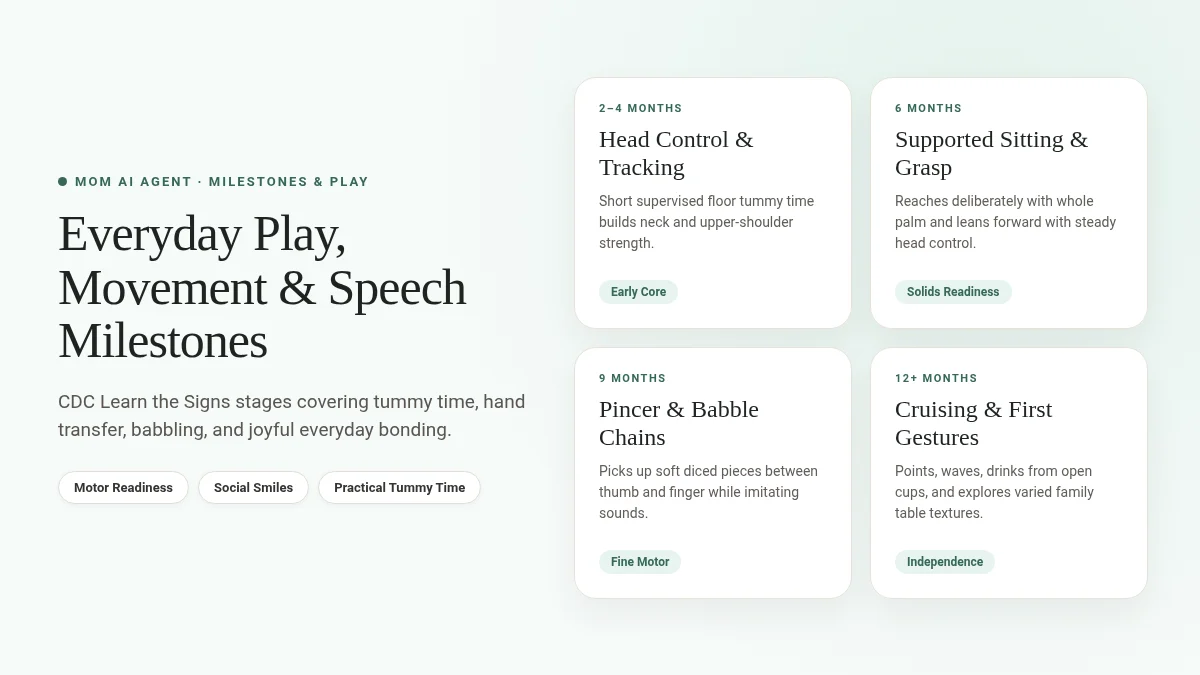
Play supports baby development by giving infants safe, everyday chances to practice age-appropriate movement, communication, social, and learning skills.
How Can Tummy Time Support Early Baby Development?
Tummy time gives babies supervised practice using early movement skills that parents can track alongside CDC milestones.
What Baby Development Milestones Matter in the First Year?
In the first year, parents should watch social, language, thinking, movement, feeding, and safety-related skills while using CDC and AAP guidance.
How Can I Support My Baby’s Development Through Play?
Support your baby’s development by using simple daily play, watching milestones, following your baby’s cues, and asking your clinician when concerns come up.
What Are the Main Stages of Baby Development in the First Year?
In the first year, babies move through early infancy, increasing interaction, readiness for solids, and growing family-meal and movement skills.
What Development Changes Are Common Around 3 Months Old?
Around 3 months, many babies show growing social awareness, stronger movement control, and more early communication.
What Are the Changes in Baby Development at 3 Months?
At 3 months, babies show significant growth in physical, cognitive, and social skills.
What Can I Expect from My 6-Month-Old Baby's Development?
At 6 months, babies typically show significant physical and cognitive development.
What Are the Different Stages of Baby Development?
Baby development includes several key stages from birth to 12 months.
How to Track My Baby's Development Stages?
Tracking your baby's development involves regular observations and using milestone checklists.
What Are the Signs of Healthy Baby Development in the Womb?
Healthy baby development in the womb includes regular movement, proper growth, and normal fetal heart rate.
What Are the Development Changes in a 6 Month Old Baby?
At six months, babies experience significant physical, cognitive, and social development changes.
What Developmental Skills Should My 8-Month-Old Baby Be Learning?
At 8 months, babies typically develop skills in motor, cognitive, and social areas.
When Should I Start Monitoring My Baby's Development Milestones?
Parents should start monitoring their baby's developmental milestones from birth.
What Are the Important Developmental Milestones for a 2-Month-Old Baby?
At 2 months, babies typically show key social, motor, and communication milestones.
Explore Other Care Hubs
View Topics Library →Feeding & Nutrition
Starting solids, first foods, allergens, breastmilk/formula storage, and US vs. Canada feeding guidance organized from official agencies.
Sleep & Routines
Safe sleep checklists, newborn-to-toddler routines, room-sharing rules, and practical nighttime rhythms grounded in official public-health guidance.
Mom Health
Postpartum physical recovery, lactation logistics, emotional check-ins, and urgent warning-sign guidance curated from official health agencies.
Safety
Choking cut sizes, food storage and hygiene, allergen readiness, fever thresholds, and urgent escalation guidelines from official health agencies.
Recipes
Age-adapted family meals, iron-rich first-food combos, allergen-aware prep notes, and quick 10-minute kitchen ideas.
Web-Native Caregiver Tools
Kitchen Reference
Foods Database
Check choking risk badges, 6m/9m/12m+ cut sizes, and allergen notes for 83+ first foods.
Meal Ideas
Stage Recipes
Browse 700+ baby and toddler recipes filtered by age stage, iron focus, and allergens.
Printable Sheets
Caregiver Toolkits
Print US/Canada fridge guides, daycare allergen cards, and bilingual EN/ZH family handoff sheets.