
Baby Feeding & Nutrition Guides
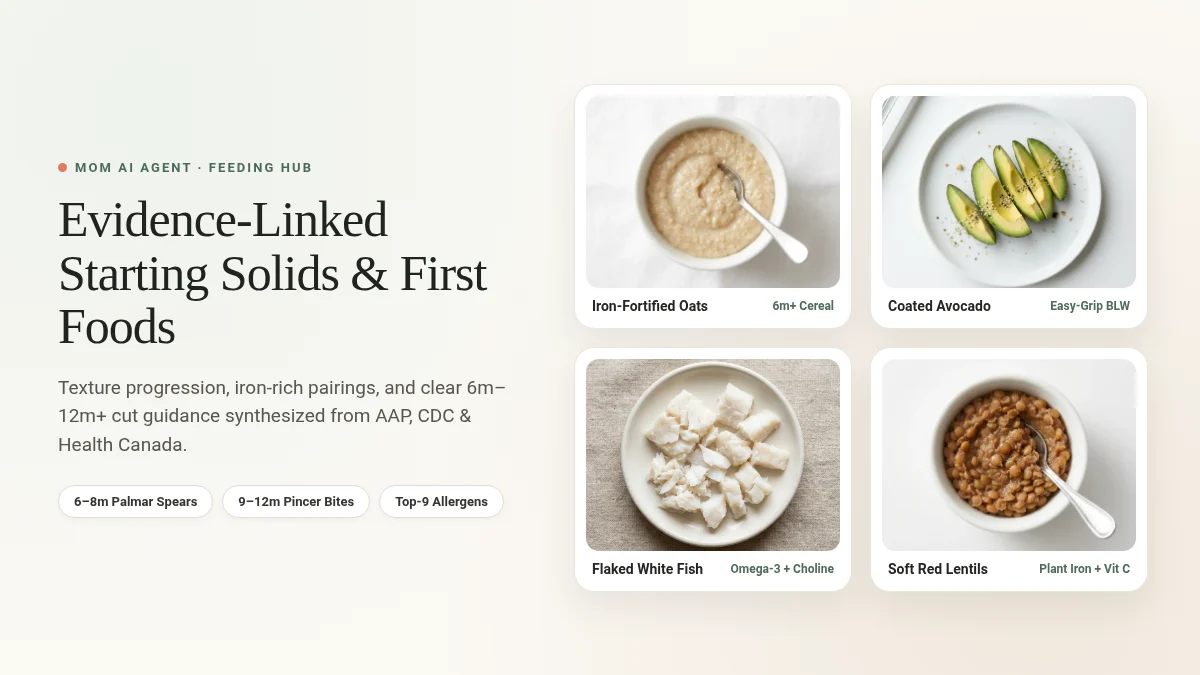
Starting solids, first foods, allergens, breastmilk/formula storage, and US vs. Canada feeding guidance organized from official agencies.
Organized from official public-health guidance (CDC, AAP, Health Canada, CPS, Alberta Health Services, NHS, and WHO). Educational reference only — not a substitute for personal medical advice.
Foods Database →
Look up age-by-age cut sizes, choking risks, and allergen flags for 83+ first foods.
100 Foods Before 1 Board →
Interactive tracker with US Top 9 and Canada Priority 11 allergen checklists.
Feeding Foundations Topic →
Readiness signs, iron-first priorities, and North American feeding guidelines.
All Feeding & Nutrition Articles & Explainers
Showing 169–192 of 367 published guides.
What Is Baby-Led Weaning and How Does It Work?
Baby-led weaning involves introducing solid foods by allowing babies to self-feed.
When Can Babies Start Eating Solid Foods?
Babies are typically ready for solid foods around 6 months of age.
How to Choose the Right Baby Formula
Choosing the right baby formula involves considering infant needs, formula types, and health guidelines.
What Are the Best Breastfeeding Positions?
The best breastfeeding positions ensure comfort and effective latching.
How Often Should I Feed My Newborn?
Newborns often feed every 1–3 hours, then settle into longer stretches. MomAI Agent helps you track feeds and follow CDC and WHO guidance on hunger cues.
Newborn Feeding Basics: Essential Guidelines for Parents
Learn the crucial aspects of feeding your newborn to ensure healthy growth and development.
Young children and food: common questions
What are healthy snacks for young children? raw vegetable sticks, such as cucumber and carrots, on their own or with hummus a plain unsweetened yoghurt with a sliced banana in it a slice of toast w
What to feed young children
Like the rest of the family, your toddler needs to eat a variety of foods. Here are some tips on the different sorts of food to offer your child, plus a few it's best to avoid. Fruit and vegetables
Vitamins for children
The government recommends all children aged 6 months to 5 years are given vitamin supplements containing vitamins A, C and D every day. Babies who are having more than 500ml (about a pint) of infant
Fussy eaters
It's natural to worry whether your child is getting enough food if they refuse to eat sometimes. But it's perfectly normal for toddlers to refuse to eat or even taste new foods. Do not worry about w
Foods to avoid giving babies and young children
Babies should not eat much salt, as it's not good for their kidneys. Do not add salt to your baby's food or cooking water, and do not use stock cubes or gravy, as they're often high in salt. Remembe
Drinks and cups for babies and young children
Solid foods and milk for your baby You should continue to breastfeed or give your baby first infant formula until they're at least 1 year old. Breastfeeding will continue to benefit you and your bab
Children's food: safety and hygiene
Keep your child safe from food bugs Babies and young children are especially vulnerable to bacteria that can cause food poisoning. Make sure your child isn't put at risk because of the way you prepa
Baby and toddler meal ideas
If you need some inspiration to help you cook healthy and tasty food for your child, try these meal ideas. These are not suitable as first foods but are fine once your baby is used to eating a wide r
Help your baby enjoy new foods
Once your baby is eating solids, it's important to give them a wide variety of foods from the 4 main food groups: pulses, meat and other proteins Getting your baby used to eating a variety of foods
Your baby's first solid foods
When to start introducing solid foods Introducing your baby to solid foods, sometimes called complementary feeding or weaning, should start when your baby is around 6 months old. At the beginning, h
Nutrition for Healthy Term Infants: Recommendations from Six to 24 Months
Learn more about the revision process. This statement by the Infant Feeding Joint Working Group provides health professionals with evidence-informed principles and recommendations. Provinces, territo
Nutrition for healthy term infants: Recommendations from birth to six months
Learn more about the revision process. This statement by the Infant Feeding Joint Working Group provides health professionals with evidence-informed principles and recommendations. Provinces, territo
Weaning - How to Stop Breastfeeding
Are you feeling ready to wean completely? Sometimes just cutting back on the amount of times you breastfeed will make you feel better, breastfeeding can sometimes be overwhelming. Breastfeeding is a t
When There Are Two—Breastfeeding Twins
Adapted from a write-up of a discussion on breastfeeding twins by Sarah Gill and Sadie Morrison at the La Leche League Great Britain (LLLGB) Conference on 15 October 2016 in Derby. First published in
The Role of the Partner in Breastfeeding: How the Support of Dads, Co-Moms and Other People Makes a Difference
A partner’s support can be one of the most important factors for a parent’s breastfeeding success. Partners can have a strong influence on whether mothers choose to breastfeed. [1] For example, in one
Smell of Stored Human Milk
Is it safe to give it to my baby? Breastmilk is food for your baby and also contains hundreds of components necessary for digestion and the protection of the baby’s health. When breastfeeding directl
Breastfeeding Skin-to-Skin Helps Baby Build a Healthy Immune System
Have you ever wondered how breastfeeding skin-to-skin can help develop a healthy microbiome for both full-term and premature babies, even in the first few months of life? Immediate skin-to-skin contac
Relactation
The good news is relactation is possible. It requires time, patience, determination and a cooperative baby! Whether you stopped breastfeeding due a medical procedure, separation from baby, or simply b
Explore Other Care Hubs
View Topics Library →Sleep & Routines
Safe sleep checklists, newborn-to-toddler routines, room-sharing rules, and practical nighttime rhythms grounded in official public-health guidance.
Mom Health
Postpartum physical recovery, lactation logistics, emotional check-ins, and urgent warning-sign guidance curated from official health agencies.
Development
Month-by-month motor skills, communication milestones, sensory play, and when to bring developmental questions to your clinician.
Safety
Choking cut sizes, food storage and hygiene, allergen readiness, fever thresholds, and urgent escalation guidelines from official health agencies.
Recipes
Age-adapted family meals, iron-rich first-food combos, allergen-aware prep notes, and quick 10-minute kitchen ideas.
Web-Native Caregiver Tools
Kitchen Reference
Foods Database
Check choking risk badges, 6m/9m/12m+ cut sizes, and allergen notes for 83+ first foods.
Meal Ideas
Stage Recipes
Browse 700+ baby and toddler recipes filtered by age stage, iron focus, and allergens.
Printable Sheets
Caregiver Toolkits
Print US/Canada fridge guides, daycare allergen cards, and bilingual EN/ZH family handoff sheets.