
Baby Feeding & Nutrition Guides
Starting solids, first foods, allergens, breastmilk/formula storage, and US vs. Canada feeding guidance organized from official agencies.
Organized from official public-health guidance (CDC, AAP, Health Canada, CPS, Alberta Health Services, NHS, and WHO). Educational reference only — not a substitute for personal medical advice.
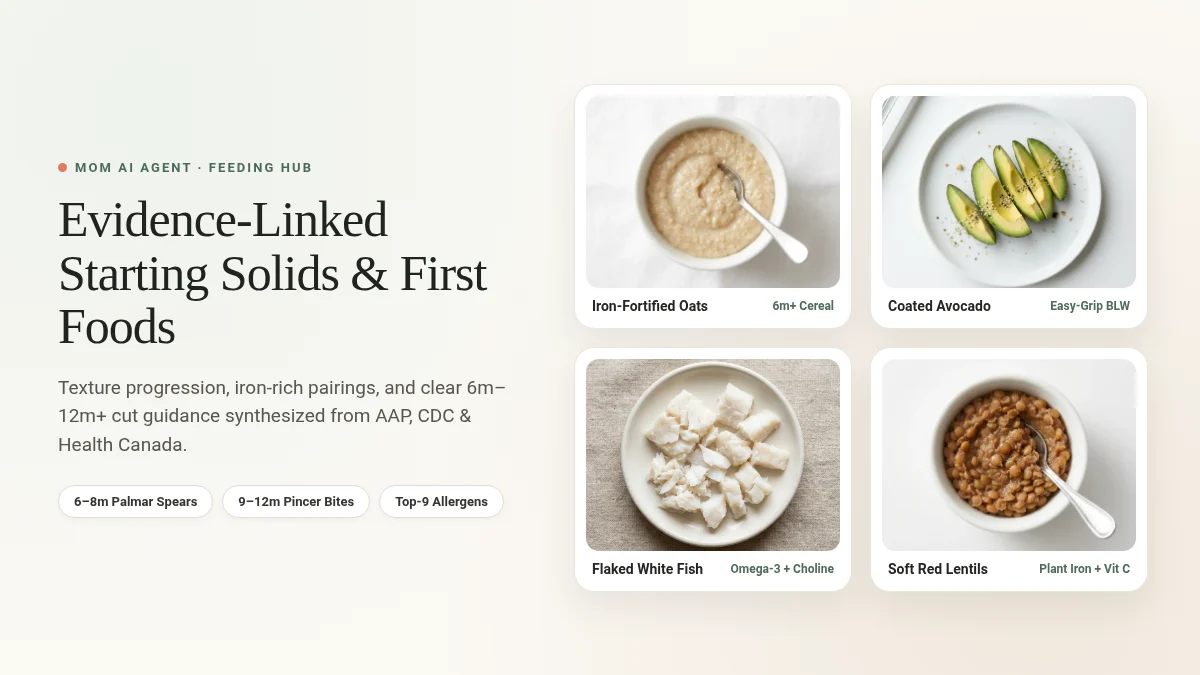
Foods Database →
Look up age-by-age cut sizes, choking risks, and allergen flags for 83+ first foods.
100 Foods Before 1 Board →
Interactive tracker with US Top 9 and Canada Priority 11 allergen checklists.
Feeding Foundations Topic →
Readiness signs, iron-first priorities, and North American feeding guidelines.
All Feeding & Nutrition Articles & Explainers
Showing 217–240 of 367 published guides.
Your baby’s growth and development – first 12 months
Your baby grows and develops from the moment they are born. At 1 month, cuddling, sleeping and feeding are all that matter to your baby. At 2 months, your baby is growing fast and becoming more alert
Tips for Promoting Social-Emotional Development in Infants and Toddlers | ZERO TO THREE
[ZERO TO THREE's logo with tagline "Every Connection Lasts a Lifetime" and an illustration of a baby being held in hands
Early Brain Development | ZERO TO THREE
[ZERO TO THREE's logo with tagline "Every Connection Lasts a Lifetime" and an illustration of a baby being held in hands
How Often Should I Feed My Baby? Tips for Infant Feeding Schedules
com/parenting/baby/baby-feeding-schedule#main-container) [
Weight Loss While Breastfeeding
You may wonder if you can return to your pre-pregnancy shape and weight after your baby’s birth. If you follow a reasonably well-balanced diet and eat in line with your appetite, you’ll probably lose
IS THRUSH CAUSING MY SORE NIPPLES?
Introduction Common reasons for ongoing nipple pain Approaches to try to help resolve painful nipples or breasts If you still suspect thrush Do I need to stop nursing or discard my milk? Persistent th
Starting Solids
According to recommendations from the World Health Organization (WHO), the American Academy of Pediatrics (AAP), and the American Public Health Association (APHA), human milk is the only food that hea
Storing Human Milk
Do you need to express and store your own milk for later use? Storing your milk according to current recommendations will help maintain its safety and quality. Following the recommendations can minimi
MASTITIS AND SORE BREASTS
Introduction Blocked ducts Milk blisters (blebs) Mastitis Abscess Recurring blocked ducts Other causes of mastitis and how to prevent it Treatments which are no longer recommended Resources You have
Positioning
Breastfeeding is a gift you can give your baby. A healthy, full term baby is likely to know instinctively what to do at the breast. During the early weeks skin-to-skin contact helps your baby connect
Importance of Breastfeeding
The Womanly Art of Breastfeeding explains that “there is almost nothing you can do for your child in his whole life that will affect him both emotionally and physically as profoundly as breastfeeding.
HIV and Breastfeeding
Introduction to HIV and BreastfeedingI want to breastfeed but am so worried. I don’t want my baby to get HIVSome facts to help your decision process What if I have to be separated from my baby?What if
Foremilk and Hindmilk
You may have heard people talking about two kinds of milk – foremilk and hindmilk. This suggests that when we are lactating we produce two distinct kinds of milk, which is not the case. Your milk-maki
Exercise
Whether you are used to running marathons or want to start some gentle activities to help with your fitness and/ or weight loss goals you might be wondering if your milk supply will be affected by exe
Special Needs
Can I still breastfeed?Breastfeeding your baby with Down syndrome is beneficialTips for breastfeeding your baby with Down syndromeResources Congratulations on the birth of your baby. How wonderful th
My Baby is Having Surgery
Surgical Procedures With AnesthesiaBefore Surgery During and After Surgery Minor Surgical Procedures Without Anesthesia Fasting Time Guidelines Around the World References When babies have major surg
Is my baby getting enough milk?
It is quite common to wonder if your baby is truly drinking enough milk at the breast. It’s nearly impossible to measure the milk, because it can’t be seen. So, how do you tell if your baby is getting
Food Allergies and Breastfeeding
ESPAÑOLBabies are more likely to develop allergies if there’s a history of eczema, asthma, hay fever or food allergies in the family. If your baby has a family history of these conditions, breastfeedi
Ten steps to successful breastfeeding
This document provides countries with various tools and strategies for monitoring adherence to the Ten Steps at the internal facility, external... The 2018 BFHI Implementation Guidance called
Coronavirus disease (COVID-19): Breastfeeding
Transmission of active COVID-19 (virus that can cause infection) through breast milk and breastfeeding has not been detected to date. There is no reason to avoid or stop breastfeeding. Yes. In all so
Safety of Homemade Infant Formulas in Canada
Health Canada advises Canadian parents and caregivers to be aware of the potential health risks associated with homemade infant formulas. Recipes for these formulas are being promoted by certain pract
Safety of Donor Human Milk in Canada
Health Canada advises Canadians to be aware of the potential health risks associated with consuming human breast milk obtained through the Internet or directly from individuals. There is a potential
Why Should Babies Not Have Honey?
Babies younger than 1 year old should not be given honey. That's because a type of bacteria (called Clostridium) that causes infant botulism can be found in honey. Infant botulism can cause muscle wea
Hearing Tests
Kids who have hearing loss have trouble hearing or understanding some or all sounds. This can happen when there is a problem with: Even mild hearing loss in children can cause problems with speech, l
Explore Other Care Hubs
View Topics Library →Sleep & Routines
Safe sleep checklists, newborn-to-toddler routines, room-sharing rules, and practical nighttime rhythms grounded in official public-health guidance.
Mom Health
Postpartum physical recovery, lactation logistics, emotional check-ins, and urgent warning-sign guidance curated from official health agencies.
Development
Month-by-month motor skills, communication milestones, sensory play, and when to bring developmental questions to your clinician.
Safety
Choking cut sizes, food storage and hygiene, allergen readiness, fever thresholds, and urgent escalation guidelines from official health agencies.
Recipes
Age-adapted family meals, iron-rich first-food combos, allergen-aware prep notes, and quick 10-minute kitchen ideas.
Web-Native Caregiver Tools
Kitchen Reference
Foods Database
Check choking risk badges, 6m/9m/12m+ cut sizes, and allergen notes for 83+ first foods.
Meal Ideas
Stage Recipes
Browse 700+ baby and toddler recipes filtered by age stage, iron focus, and allergens.
Printable Sheets
Caregiver Toolkits
Print US/Canada fridge guides, daycare allergen cards, and bilingual EN/ZH family handoff sheets.