
Baby Feeding & Nutrition Guides
Starting solids, first foods, allergens, breastmilk/formula storage, and US vs. Canada feeding guidance organized from official agencies.
Organized from official public-health guidance (CDC, AAP, Health Canada, CPS, Alberta Health Services, NHS, and WHO). Educational reference only — not a substitute for personal medical advice.
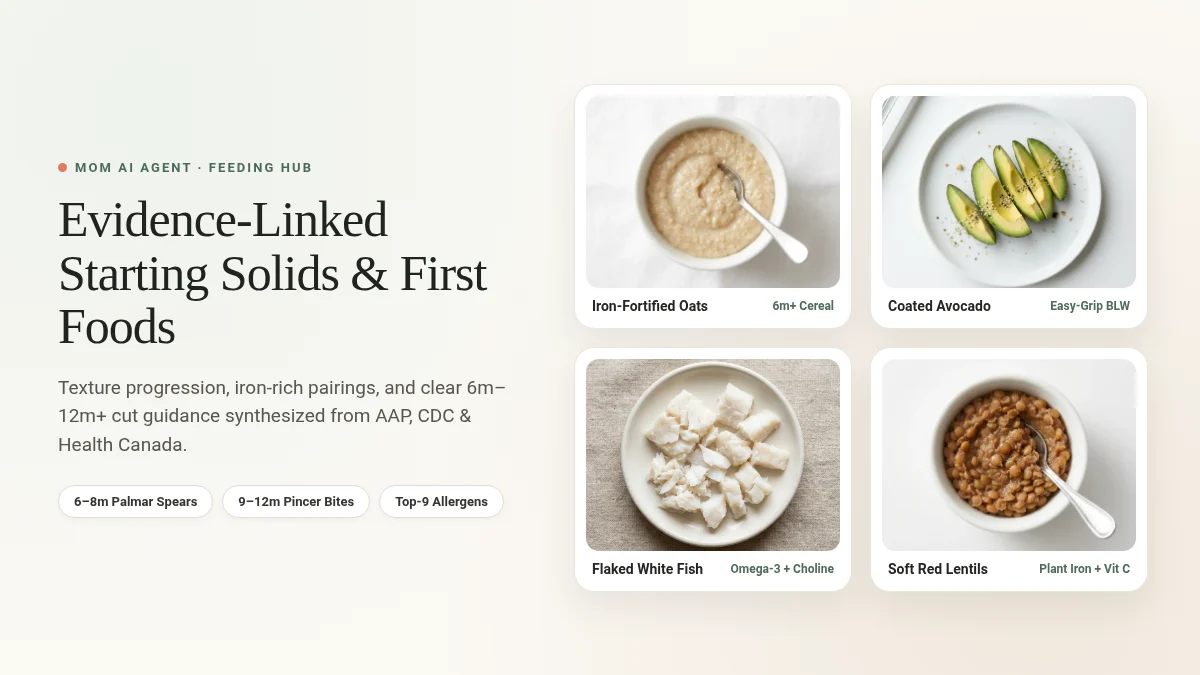
Foods Database →
Look up age-by-age cut sizes, choking risks, and allergen flags for 83+ first foods.
100 Foods Before 1 Board →
Interactive tracker with US Top 9 and Canada Priority 11 allergen checklists.
Feeding Foundations Topic →
Readiness signs, iron-first priorities, and North American feeding guidelines.
All Feeding & Nutrition Articles & Explainers
Showing 193–216 of 367 published guides.
Persistent Pain When Breastfeeding
Cindy Garrison, Canonsburg, Pennsylvania, USA Breastfeeding is not supposed to hurt. Yet many mothers and nursing parents complain of pain associated with breastfeeding, which can be a leading cause
Breast Milk Oversupply and Overactive Milk Ejection Reflex
You may make more milk than your baby needs. Although this may sound like a good problem to have, too much of any good thing can cause challenges – for you and your baby. What are some signs of over
Nursing Strike - Common Causes & How to Overcome Them
A baby who is truly ready to wean will almost always do so gradually, over a period of weeks or months. If your baby or toddler has been breastfeeding well and suddenly refuses to nurse, it is probabl
Menstruation - Your Period While Breastfeeding
Human beings have known for centuries that breastfeeding affects fertility, and this has been borne out in recent studies. The effects of breastfeeding on fertility vary greatly between individuals.
Lyme Disease and Breastfeeding
Adapted from an original article in e-Blender, the Area Leader Letter for LLL of New York, USA. In the Northern Hemisphere, spring and summer weather brings fun opportunities for families. After bein
Islamic and Cultural Practices in Breastfeeding
Breastfeeding is important to me for several reasons. One reason is my religion. As a Muslim parent, I always try to follow Islamic guidelines and I was fascinated to discover breastfeeding is mention
Eight Strategies for Breastfeeding During a Natural Disaster
Earthquakes strike when you least expect them, and I certainly had not planned for a 7.8 magnitude earthquake while on vacation with my family in Costa Rica. I managed to duck and cover with my 23-mon
Green Feeding: Breastfeeding for a Healthy Planet
You are breastfeeding and happy about doing so. Your motivations may be varied – to give your baby an optimal start in life, to consider health issues or family tradition, or just to cuddle your baby
Resiliency Comes in All Sizes: Breastfeeding a Baby with Down Syndrome (Part 2 of 2)
The following is the second half of a story spanning two issues of Breastfeeding Today. (For part one, click here to view it in our April issue.) Now 34 days old, my sweet little boy had already prov
Resiliency Comes in All Sizes: Breastfeeding a Baby with Down Syndrome (Part 1 of 2)
Find part 2 of Sabrina’s story here. I have what I would consider a long history of mothering. I have always been a nurturer. As a little girl, I enjoyed watching over my younger siblings. As I got o
Parenting Post COVID-19: Breastfeeding and Beyond
We’ve ended up with a distorted sense of time after the last year and a half, but the world didn’t actually stop. It is estimated that 116 million babies were born during just the first 9 months of th
Breastfeeding, Childbirth, and COVID-19
Contact Information: zion@llli.org 16 April 2020, Raleigh, North Carolina, USA (Update to our media release of 19 February 2020, and subsequent Breastfeeding and Coronavirus resources published 4 Mar
Colostrum
Colostrum is produced from before birth through the first few days of life. It is followed by transitional milk, a mix of colostrum and mature milk, and then by mature milk, from about the second week
Breastfeeding in Public Spaces
Originally published November 2015, and republished with the express permission of the author. Photo: Karsyn Shalae Photography Thirty-five years ago, when my first baby was about six weeks old, I f
How to Get a Breastfed Baby to Take a Bottle
The information in this post is also contained in our Working & Breastfeeding. Here is one approach to beginning pumping and introducing bottles that has worked well for many mothers as they prepared
Bottles and Other Tools - How to Get Baby to Take a Bottle
When the nursing parent and baby are separated or the baby cannot feed at the breast, they may need another way of taking breastmilk. These tips assume that your baby is being fed expressed breastmilk
Bridging Birth and Breastfeeding
When I began my certification process to become a childbirth educator in 2000, there was a small section on breastfeeding. We learned the basic information and were guided towards breastfeeding being
Back to Breast: 10 Ways to Relactate After a Period of Not Breastfeeding
Do you dream of getting your formula-fed baby back to breastfeeding at your breast, but the milk is no longer flowing? Consider relactation! Relactation refers to the process of reestablishing milk pr
CMPI – Cow’s Milk Protein Intolerance
Usually when it is recommended that you eliminate dairy produce from your diet, it is because of a problem that may be caused by a protein in dairy, not because of lactose intolerance. Human milk is f
Breastfeeding Without Giving Birth
Alyssa Schnell is an International Board Certified Lactation Consultant (IBCLC) based in the United States. She speaks internationally about inducing lactation and relactation and specializes in helpi
Newborn health - head to toe infographic
View text version of infographic Moving their arms and legs (not limp or ‘floppy’). Might be an unusual shape from birth, should go back to a normal shape by around 6 weeks. Typically present from
Baby poo colour chart
View text version of infographic There is a variety of colours and textures when it comes to baby poo. It will depend on their age, whether they are breastfed or formula fed, and if they have started
Baby monitors and sensors
A baby monitor can help you watch your baby from a distance, or to track their heart rate or breathing. Different baby monitors can track audio (sound) and video (images) of your baby, as well as the
Baby carriers, slings and backpacks
You can choose to carry your baby in your arms or use a baby carrier, sling or backpack. If you use baby carriers, slings and backpacks correctly, they are safe and practical ways to carry your baby.
Explore Other Care Hubs
View Topics Library →Sleep & Routines
Safe sleep checklists, newborn-to-toddler routines, room-sharing rules, and practical nighttime rhythms grounded in official public-health guidance.
Mom Health
Postpartum physical recovery, lactation logistics, emotional check-ins, and urgent warning-sign guidance curated from official health agencies.
Development
Month-by-month motor skills, communication milestones, sensory play, and when to bring developmental questions to your clinician.
Safety
Choking cut sizes, food storage and hygiene, allergen readiness, fever thresholds, and urgent escalation guidelines from official health agencies.
Recipes
Age-adapted family meals, iron-rich first-food combos, allergen-aware prep notes, and quick 10-minute kitchen ideas.
Web-Native Caregiver Tools
Kitchen Reference
Foods Database
Check choking risk badges, 6m/9m/12m+ cut sizes, and allergen notes for 83+ first foods.
Meal Ideas
Stage Recipes
Browse 700+ baby and toddler recipes filtered by age stage, iron focus, and allergens.
Printable Sheets
Caregiver Toolkits
Print US/Canada fridge guides, daycare allergen cards, and bilingual EN/ZH family handoff sheets.